

Patient collections are the portion of your revenue that comes from the patient rather than the insurer, and for most independent practices that portion has quietly become the difference between a comfortable month and a tight one. The short answer to improving patient collections is unglamorous. Collect before the patient leaves the building. Everything that happens after the visit costs more, takes longer, and returns less. A statement cycle, three phone calls, and eventually a collection agency all sit downstream of a ten second conversation your front desk could have had at check in.
The reason this matters more every year is the deductible. According to KFF’s 2025 Employer Health Benefits Survey, 88% of covered workers with single coverage have a general annual deductible, and the average was $1,886 in 2025. At firms with 10 to 199 workers the average deductible was $2,631, against $1,670 at larger employers. If your panel skews toward employees of small businesses, a meaningful share of your commercial revenue is not really commercial revenue at all. It is a bill you are sending to a household.
Below are nine steps that improve patient collections in a real practice, followed by what we found in our own clinic when we reconciled patient balances against posted payments. That reconciliation changed how we think about the problem, and it is the part most articles on this topic cannot tell you.
What counts as patient collections?
Patient collections covers every dollar the patient owes directly: copays, coinsurance, deductible balances, non covered services, cash pay visits, and any balance left after the payer adjudicates. It does not cover the payer side of the claim. If a claim is denied or underpaid, that is a claims problem, and the fix lives in your denial management process rather than at the front desk.
The distinction matters because practices routinely treat one problem as the other. A growing self pay aging report is sometimes a patient collections failure and sometimes a symptom of claims being adjudicated to patient responsibility when they should not have been. Before you retrain the front desk, look at a sample of the balances and confirm they are genuinely the patient’s.

9 steps to improve patient collections
1. Verify eligibility and benefits before every visit, not at the visit
You cannot ask for a number you do not have. Run eligibility 48 to 72 hours ahead so that a staff member has time to resolve the exceptions: a terminated plan, a changed member ID, a secondary that was never recorded. Same day verification produces a queue of unresolved cases at exactly the moment the waiting room fills.
2. Quote the expected patient responsibility in advance
Patients pay what they expect. They resist what surprises them. Once eligibility is back, calculate the expected balance from your contracted rate and the patient’s remaining deductible, and put that number in front of them before the visit by text or portal message. For uninsured and self pay patients this is not optional courtesy. Federal rules require a good faith estimate of expected charges, which we cover in our guide to No Surprises Act compliance.
3. Ask at check in, not check out
Checkout is the worst moment to ask for money. The patient is finished, often distracted, sometimes uncomfortable, and always closer to the door. Move the ask to check in, when the transaction is still in front of them rather than behind them. Of the nine steps here, this is the one that tends to move patient collections fastest, and it costs nothing to try.
4. Keep a card on file with written authorization
A signed card on file agreement, stating the maximum amount you may charge and requiring a receipt within a set number of days, converts the post visit balance from a collections exercise into a posting entry. Store the card with a compliant vault through your merchant processor rather than in your practice management system, and give patients a plain English copy of what they signed.
5. Offer payment plans with a floor and an end date
An open ended plan at twenty dollars a month on a two thousand dollar balance is a write off with extra steps. Set a minimum monthly amount, a maximum term, and automatic payment from the card on file. Practices that do this collect more and spend far less staff time chasing than practices that negotiate every plan individually.
6. Give the front desk words and permission
Most front desk staff are not reluctant to collect because they lack a script. They are reluctant because nobody has told them it is their job and that management will back them up when a patient pushes back. Write the exact sentences you want used, role play them, and make it clear who handles an escalation. If your front office is short staffed or churning, fix that first; our guide to medical practice staffing covers the hiring and retention side.
7. Reconcile what was collected against what was posted
Money collected at the desk and money posted to the ledger are two different numbers, and in most practices nobody compares them. This is where patient collections quietly leak. Do it weekly. Match the merchant processor’s daily batch to the payments posted in the practice management system, and investigate every variance rather than writing it off as timing.
8. Give your statement cycle an end
Decide in advance how many statements a balance gets, at what interval, and what happens on the last one. Then follow the policy. An indefinite statement cycle is the most expensive way to not collect money, because it consumes postage and staff attention forever while signaling to the patient that nothing will actually happen.
9. Measure three numbers and only three
Point of service collection rate, net collection rate, and days in accounts receivable will tell you almost everything about your patient collections performance. Track them monthly against your own trend rather than an industry average, and read them alongside the rest of your practice KPIs so that a change in one is interpreted in context.
What we found reconciling patient balances in our own clinic
Our team does not only advise practices. We run a musculoskeletal and regenerative medicine clinic, and in July 2026 we reconciled patient account balances in the practice against the payments posted against them. Three findings about patient collections are worth passing on, because none of them are visible from a benchmarking report.
The first is that most of what looked like collectible patient balance was not refusal to pay. It was missing history. On balances that had been carried over from a previous billing system, more than nine in ten imported lines had no charge detail at all, and the patient paid portion was absent on every visit year before the most recent one. The balance column looked like money owed. In reality the payment side simply was not visible, so the balance could not be trusted in either direction.
That produced the second and more useful finding. Aged patient balance is not two buckets, it is three: collectible, write off, and unknown. Most practices only maintain the first two, so everything unknown gets quietly treated as collectible, chased for months, and eventually written off after the staff time has already been spent. Separating the unknown bucket and reconstructing it deliberately is cheaper than working it as if it were real.
The third finding came from automation. When we connected the payment records in our CRM to the practice management system so that patient payments would post automatically, the first thing that surfaced was duplicates, because staff had been hand keying some of those same payments. Any practice automating payment posting needs a duplicate guard before it needs anything else. You also learn something you did not want to know: how much of your posting was manual all along.
How much should a practice collect at the point of service?
Benchmarks for patient collections are thinner than practices assume, and most published figures come from hospitals rather than physician offices. The best current reference point is Kodiak Solutions data reported by HFMA in June 2026, which found that point of service collections made up 30.1% of patient payments in the first quarter of 2026, slightly down from 30.6% a year earlier, while the point of service collection rate climbed to 24.8% of patient payments from 22.7%.
Treat those as directional. A practice with a heavy Medicare Advantage or Medicaid managed care mix will not produce the same point of service percentage as a practice full of commercial high deductible plans, and comparing yourself to the wrong denominator will send you chasing a number you were never going to hit. If you have not looked at that composition recently, start with a payer mix analysis and set your own baseline from it.
When should a balance go to collections?
This is the last stop in patient collections, and it should be reached by policy rather than by mood. Make the threshold a function of balance size, age, and whether the patient has responded at all. A patient who is paying fifty dollars a month is not a collections candidate no matter how large the balance. A patient who has ignored four statements on a small balance may not be worth an agency fee either.
The credit reporting landscape has shifted twice in recent years, and it is worth knowing where it stands. The three national credit bureaus stopped reporting paid medical collections as of July 1, 2022, extended the wait before unpaid medical collections appear from six months to one year, and announced on April 11, 2023 that medical collections with an initial reported balance under $500 had been removed. The CFPB rule that would have removed medical debt from credit reports altogether was vacated by a federal court in the Eastern District of Texas on July 11, 2025, so it is not in force.
For a practice, the practical read is straightforward. Credit reporting is a weaker lever than it used to be on small balances, which makes collecting at the visit more valuable rather than less.
Frequently asked questions about patient collections
Can we require payment before the appointment?
You can require payment of the expected patient responsibility at or before the visit for most non emergency services, provided your financial policy says so, the patient has seen it, and you apply it consistently. Check your payer contracts, since some restrict what may be collected up front, and never withhold emergency care over a balance.
What is a reasonable point of service collection target?
Rather than adopting an external target, measure your own point of service rate for a quarter and then improve it deliberately. The steps that move it most are advance eligibility, a quoted number before the visit, and asking at check in instead of checkout.
Should we outsource patient collections?
Early stage patient balances usually belong in house, because the same staff who created the balance can resolve it fastest and the patient relationship is still intact. Outsourcing tends to make sense at the aged end. If you are weighing the wider question of what to keep in house, our guide to outsourcing medical billing works through the tradeoffs.
How do prior authorizations affect patient collections?
Directly. A service performed without a required authorization is frequently denied in a way that leaves the patient holding a balance they did not expect, which is the hardest kind to collect and the most damaging to the relationship. Tightening your prior authorization process removes a meaningful slice of avoidable patient balance before it is ever created.
How often should we review patient collections performance?
Monthly for the three numbers, weekly for the reconciliation between what the desk collected and what was posted. The reconciliation is the one most practices skip, and it is the one that catches problems while they are still small.
Where to start
If you only change one thing this quarter, move the ask from checkout to check in and give your staff a quoted number to say out loud. If you change two, add the weekly reconciliation. Patient collections improve through a handful of small operational habits held consistently, not through a new system.
Practice Management Consultancy advises independent practices on billing, payer contracting, credentialing, compliance, and access to capital, and our team runs a clinic of its own. If you want a second opinion on where your patient collections are leaking, call (706) 909-3271 or get in touch.
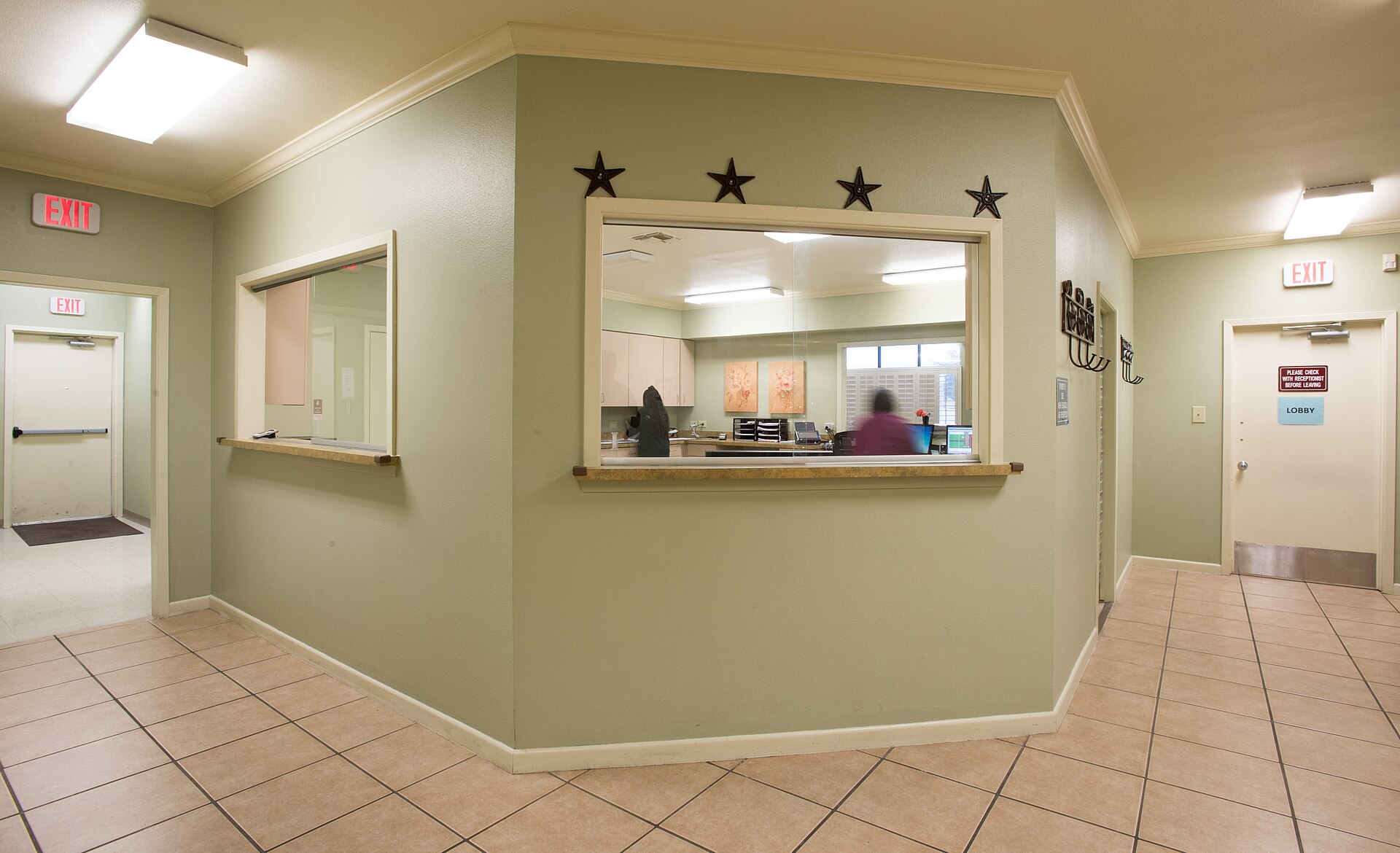
Image credits: patient registration desk photo by Mjschmidt715, via Wikimedia Commons, licensed CC BY 3.0. Reception and front office photos are public domain works of the U.S. Navy and the U.S. Department of Agriculture.
Disclosure: our team operates and manages the medical practice referenced in first-person examples on this site.
Want a second opinion on this?
We run a clinic ourselves, so these decisions cross our desk every week. If you want to talk one through for your own practice, request a short call. We reply within one business day.